
Mastering Your Miter Saw: The Essential Tool for Every DIY Enthusiast
A new year often brings a fresh wave of inspiration, especially for those eager to dive into home improvement or craft engaging woodworking projects. Many aspiring creators frequently ask us: “What tools do I truly need to get started?” While the world of power tools can seem daunting at first glance, there’s one incredibly versatile and user-friendly machine that consistently tops our list for beginners and seasoned DIYers alike: the miter saw. It’s not just a tool; it’s a cornerstone for achieving precise, professional-looking cuts on countless projects, from intricate trim work to robust furniture builds.
Our journey into woodworking began much like many others – with small, manual hand saws. While these humble tools certainly teach patience and basic cutting principles, it quickly became clear that efficiency and accuracy demanded an upgrade. The miter saw transformed our workshops, making quick work of repetitive cuts and enabling a level of precision that was simply unattainable by hand. If you’ve been hesitant to incorporate power tools into your arsenal, we sincerely hope this comprehensive guide and our accompanying video empower you to embrace the miter saw and unlock a new realm of creative possibilities.
Unlock Precision: Your Guide to Using a Miter Saw
Understanding how to safely and effectively operate a miter saw is crucial for any project, big or small. Our detailed video demonstration simplifies the process, walking you through everything from basic setup to making accurate cuts. We encourage you to watch our How to Use a Miter Saw video on YouTube HERE to see this incredible tool in action. Don’t hesitate to share your thoughts, and as always, feel free to ask any questions you might have about its operation or applications!
Choosing the Right Miter Saw: A Guide for Every Project and Budget
Once you recognize the immense value a miter saw brings to your workshop, the next natural question is: “Which miter saw is right for me?” The market offers a wide array of options, each designed to meet different needs, space constraints, and budget considerations. From compact, portable models perfect for small crafts to robust, professional-grade machines capable of handling large-scale construction, there’s a miter saw out there for everyone. Remember, while a higher investment often translates to more features, greater power, and enhanced durability, even entry-level models offer significant improvements over manual cutting methods.
Understanding Miter Saw Types and Their Capabilities
Before diving into specific recommendations, it’s essential to understand the different types of miter saws available and what makes each unique:
- Standard Miter Saw: The most basic type, designed primarily for cross-cutting and making angled (miter) cuts. It’s excellent for simple trim work and repetitive cuts on narrower boards.
- Compound Miter Saw: This popular upgrade allows for both miter (angled) cuts and bevel (sloped) cuts. This means you can cut a board at an angle while also tilting the blade, creating intricate compound angles essential for projects like crown molding or complex framing.
- Sliding Compound Miter Saw: Expanding on the compound saw, the sliding mechanism allows the blade and motor to move along rails, significantly increasing the saw’s cross-cutting capacity. This feature is invaluable for wider materials like shelving, decking, or larger lumber, making it a favorite for many serious DIYers and professionals. Some models are “dual bevel,” meaning the head can tilt both left and right, eliminating the need to flip your workpiece for opposing angle cuts.
- Cordless Miter Saws: Offering unparalleled portability, these saws run on powerful rechargeable batteries. They are ideal for job sites without immediate power access, quick setup for small tasks, or when working far from an outlet. While their cutting capacity and power might be slightly less than corded counterparts, advances in battery technology are rapidly closing this gap.
Key Features to Consider When Buying Your Miter Saw
Beyond the basic type, several features can significantly impact your miter saw experience:
- Blade Size: Common sizes include 7-1/4 inches, 10 inches, and 12 inches. A larger blade typically allows for deeper and wider cuts. A 10-inch saw is a great all-rounder for most DIY tasks, while a 12-inch provides maximum capacity for larger dimensional lumber.
- Motor Power (Amperage): Higher amperage (e.g., 15 amps) indicates a more powerful motor, which can cut through tougher materials like hardwoods more easily without bogging down.
- Laser Guide: Many saws include a laser that projects a line onto your workpiece, showing exactly where the blade will cut. This feature greatly enhances accuracy and reduces guesswork.
- Dust Collection: A good dust collection system or port allows you to connect a shop vac, keeping your workspace cleaner and safer by minimizing airborne sawdust.
- Fence and Clamps: A robust fence provides stable support for your material, and integrated clamps help secure your workpiece for safer, more precise cuts.
- Portability: If you plan to move your saw frequently or work on different sites, consider its weight and whether it can be easily transported or mounted on a miter saw stand.
Our Top Miter Saw Recommendations for Every DIY Level
Based on our extensive experience and the diverse needs of our community, we’ve curated a selection of miter saws that stand out for their performance, value, and suitability for various projects. Here are a few of our absolute favorites, designed to help you make informed decisions:
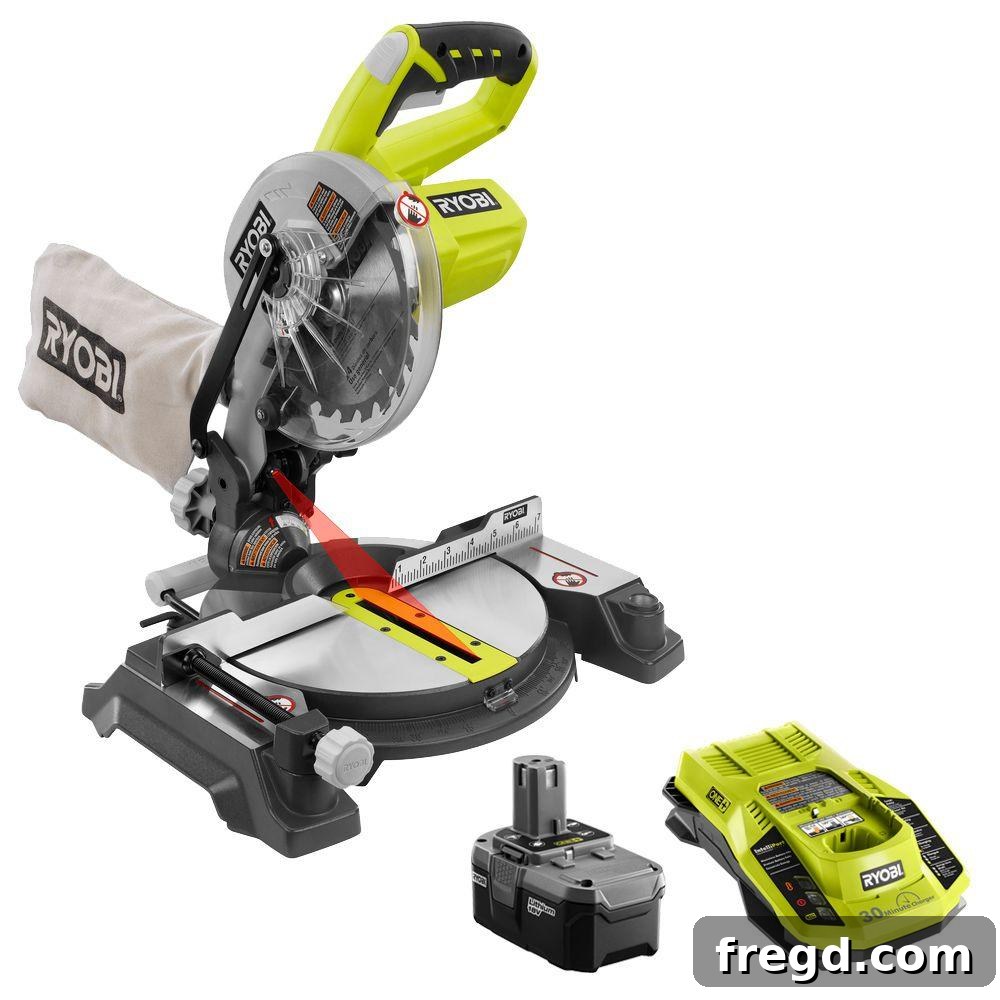
1. The Compact and Cordless Champion: Ryobi 18V Miter Saw
For those just starting out, or anyone needing ultimate portability and convenience for smaller tasks, the Ryobi 18V Miter Saw is a game-changer. Imagine the freedom of making quick, precise cuts anywhere without being tethered to an outlet! This battery-powered marvel is remarkably small and lightweight, making it incredibly easy to transport and store, even in compact workshops or apartments. It’s perfectly suited for common smaller lumber dimensions like 1x3s and 1x4s, ideal for craft projects, picture frames, small trim work, or quick repairs around the house.
Despite its compact size, it delivers impressive accuracy for its class. This saw is an excellent entry point for beginners to get comfortable with power tools, or for seasoned crafters who value efficiency and untethered operation. It’s a testament to how far cordless technology has come, offering ample power for its intended applications.
Ryobi 18V Miter Saw – Check Latest Price
2. The Versatile Mid-Range Performer: Ryobi 10″ Sliding Miter Saw
Stepping up in capability, the Ryobi 10″ Sliding Miter Saw offers a fantastic blend of features, performance, and affordability, making it an excellent choice for a wide range of DIY projects. What sets this saw apart is its sliding mechanism, which significantly extends its cross-cutting capacity compared to a standard miter saw. This means you can easily cut wider boards, such as 1x10s or 2x10s, in a single pass – a crucial advantage for building shelves, larger cabinets, or deck railings.
The 10-inch blade size is highly versatile, striking a perfect balance between power and maneuverability. Coupled with its competitive price point, this saw delivers exceptional value for those ready to tackle more ambitious woodworking or home improvement tasks. It’s often equipped with a laser guide, further enhancing its precision and ease of use, making it a go-to for many intermediate DIY enthusiasts.
Ryobi 10″ Sliding Miter Saw – Explore Features
3. The Professional Powerhouse: Ridgid 12″ Sliding Compound Miter Saw
For serious DIYers, small contractors, or anyone who demands the ultimate in power, precision, and versatility, the Ridgid 12″ Sliding Compound Miter Saw is our unequivocal recommendation – it’s the workhorse both of us currently rely on and absolutely love. This robust machine combines a larger 12-inch blade with both sliding and compound cutting capabilities, allowing it to handle virtually any cut imaginable with ease. From thick dimensional lumber for framing to wide boards for intricate furniture pieces, this saw delivers consistently accurate results.
Its powerful motor and durable construction are designed for heavy-duty use, ensuring longevity and reliable performance. The larger blade provides increased cutting depth and capacity, making it suitable for even the most demanding projects. While it represents a greater investment, the Ridgid 12″ Sliding Compound Miter Saw pays dividends in terms of efficiency, precision, and the sheer breadth of projects it can effortlessly facilitate. If you’re looking for a professional-grade tool that will be the centerpiece of your workshop for years to come, this is the one.
Ridgid 12″ Sliding Compound Miter Saw – Our Top Pick
Beyond the Purchase: Maximizing Your Miter Saw Experience
Acquiring the right miter saw is just the first step. To truly unlock its potential, consider these additional tips and applications:
- Essential Accessories: A sturdy miter saw stand provides a stable and ergonomic workspace. Invest in various blades – different tooth counts are optimal for different materials (e.g., fewer teeth for rough cuts, more teeth for fine finishing).
- Safety First, Always: Always wear appropriate safety gear, including eye protection and hearing protection. Ensure your workpiece is clamped securely before cutting. Understand your saw’s safety features, such as blade guards and electric brakes.
- Common Applications: Your miter saw will become indispensable for installing baseboards and crown molding, building custom furniture (tables, chairs, cabinets), creating picture frames, constructing decks and fences, and accurately sizing lumber for any renovation project.
- Practice Makes Perfect: Start with scrap wood to familiarize yourself with the saw’s operation, especially when making miter, bevel, or compound cuts. This builds confidence and ensures accuracy on your actual project pieces.
Start Your DIY Journey with Confidence
The miter saw is more than just a tool; it’s an investment in your DIY capabilities, transforming complex cuts into simple, precise tasks. Whether you’re a complete beginner or an experienced crafter, choosing the right miter saw can significantly enhance your woodworking experience and the quality of your finished projects. We’ve seen firsthand how this one tool can inspire creativity and empower individuals to tackle projects they once thought impossible.
Don’t let the initial learning curve deter you. With the guidance in our video, these recommendations, and a commitment to safety, you’ll be making perfect cuts in no time. So, take the leap, explore the possibilities, and confidently embark on your next DIY adventure!